Sunday, August 10, 2014

But, how can they believe that and still be Jews (or Muslims, or Buddhists, etc.)?

My course studying different religious viewpoints and philosophies is halfway done and we have had a lot of interesting things happening in the last couple of weeks. 

To begin with, one of the required class activities was to visit a place of worship of another religion in order to hear directly from the perspective of non-Christians. I ended up organizing two class trips, one to a Tibetan Buddhist center and one to a mosque. Besides the mere fact of seeing that non-Christian religions exist in Medellín, I think the biggest value for students was seeing how what can seem like abstract philosophies or belief systems affect the lives of their followers. 

Students seemed a little taken aback at the Buddhist Center at how naturally the people there talked about reincarnation, karma, and so forth as completely common sense notions. (The person sharing wasn't Tibetan either, but a Colombian woman who has been a Buddhist for 14 years). 

At the mosque, the biggest surprise for students was hearing firsthand from a Muslim about how he does not believe that Islamic extremism has any real basis in the teachings of Islam. Many, myself included, had serious questions about his interpretation of the violence in the Middle East as 100% political and having nothing to do with religion, but it does go to show how important it is to listen and understand what particular people believe rather than stereotyping people from other faiths as monolithic wholes.

In that regard, probably the most surprising thing my students have heard so far came in a class on modern Judaism this past week. Two students did a presentation on contemporary Jewish views of the Messiah and interviewed a local rabbi as part of their research. They found out that many Jews don't believe in a personal Messiah figure, that they don't think the sacrificial system is necessary for salvation, that there's not a big push among many Jews to rebuild the temple, and that it's a common Jewish viewpoint to believe in reincarnation until the individual achieves his purpose for life by living righteously. Many students seemed stunned, because the tendency is to assume that Jews today are basically the same as Jews in the time of Jesus and that the political aspirations of evangelicals who hold to certain forms of dispensational theology are also the aspirations of all Jews.

We have also had some in-class debates where students have to defend an assigned religious viewpoint to the best of their ability. The goal isn't to win the debate so much as show an understanding of the strengths and weaknesses of different positions and an ability to respond to common objections. Our first one was a debate between Buddhist and Christian views of the nature of the human problem and how to overcome it. This week we're having one between Christian and Muslim viewpoints on the divinity of Christ. The third debate toward the end of the course will be on whether we need to affirm the existence of God in order to make sense of ethics. This will bring together a number of strands of upcoming classes dealing with naturalism, applications of naturalistic Darwinism to broader worldview issues (especially ethics), and existentialism. 

One of my biggest goals for this class is to develop critical thinking skills in students as they look at different religions and philosophies. Hopefully these activities are proving helpful for truly equipping students to engage critically with people who often think and live in drastically different ways.

Sunday, July 27, 2014

More Medellín Photos

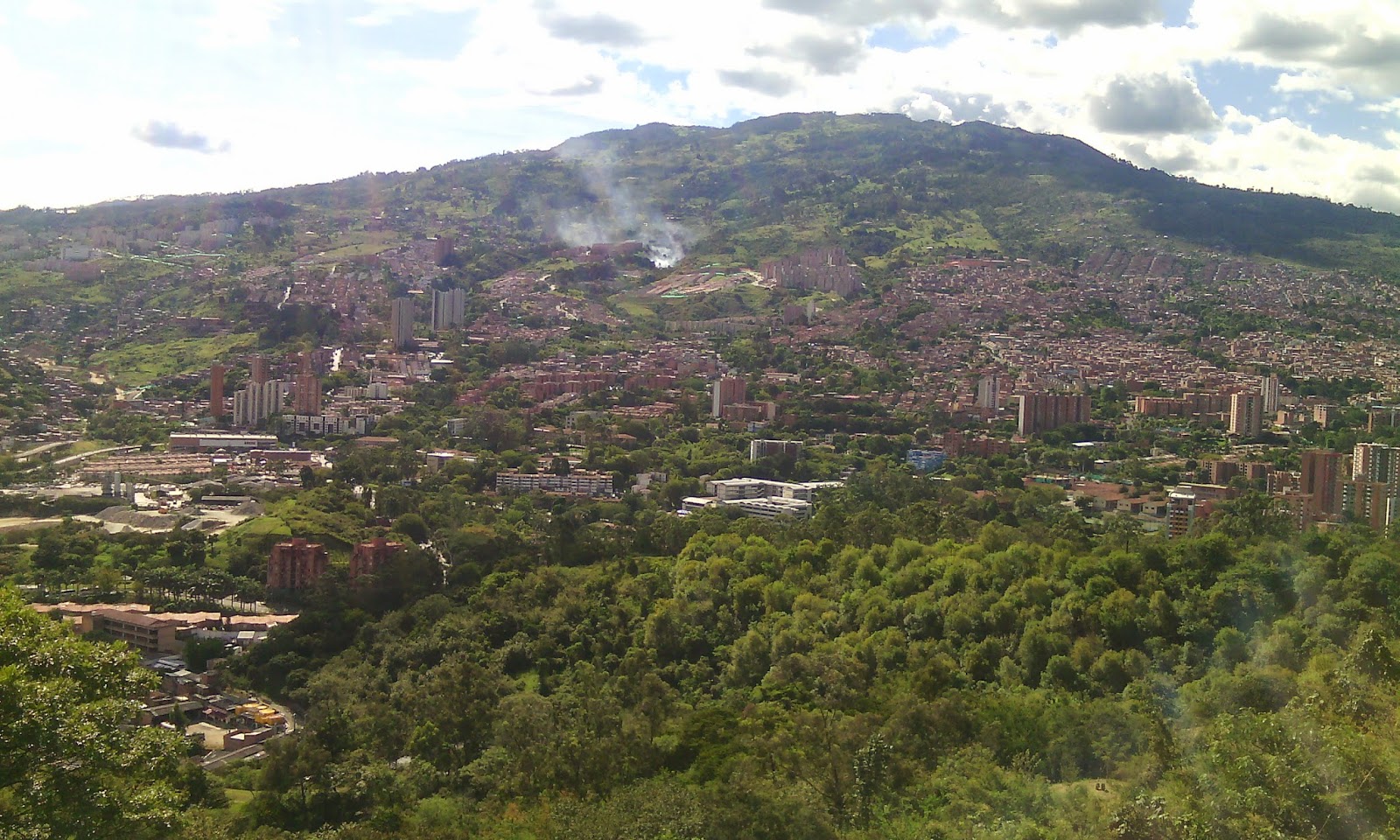
View east from Cerro el Volador, a natural park on the top of a hill in the middle of Medellín, close to the seminary. If you look closely in the middle of the photo in the green area, you can see the raised train tracks of the Metro system.

View north from Cerro el Volador.

View southeast from Cerro el Volador.

View south from Cerro el Volador, looking at the park itself.

View southwest from Cerro el Volador.

View west from Cerro el Volador. The seminary is somewhere around the middle of the photo.
Watching the Colombia-Brazil World Cup match.

After a seminary chapel service, which we have every Thursday.
A street I often walk through on my way to the grocery store.
Metro tracks in the bottom of the valley.
A Catholic church and park I often walk by on the way to the grocery store.

Metro tracks and view of city.

In the city center.

View from a Metro station.

Metro train. They are amazingly clean, modern, and don't have people trying to sell anything on them. (This was a big shock after Mexico City. Busses here are another story.)

Sunday, July 13, 2014

Gender Equality Conference

This past Monday evening through Wednesday morning the Biblical Seminary of Colombia hosted a conference put on by Christians for Biblical Equality, an organization that advocates for the involvement of women in all ministries of the church and for gender equality in marriage. I ended up attending most of the sessions and doing some simultaneous Spanish to English translation for some of the introductory comments and one of the talks by Dr. Bill Spencer, a professor from Gordon-Conwell Theological Seminary, which addressed debates over Trinitarian theology as it relates to gender roles. This was my first time doing simultaneous translation, and I actually really enjoyed it. Thankfully I was going from Spanish to English, which is a lot easier than the reverse!

Sessions of the conference addressed issues related to interpretation of Old Testament and New Testament texts, theology, church history, and practical issues. Half a day was devoted to workshops, which I decided to use to attend workshops related to women’s standing according to Colombian law and issues of gender violence. These were helpful for understanding a bit more of the cultural context here in Colombia and the challenges and inequalities women still face. While not mentioned in these talks, it’s worth mentioning that one of the big challenges women face in ministry in Colombia is that churches often theologically accept women pastors, but they don’t want to pay them, or at least not at the rate they pay male pastors. It’s quite common to see pastoral teams of husband and wife here, and there is often a “two for the price of one” mentality.

The view from the translator's booth. I listened to the Spanish via headphones and simultaneously spoke an English translation, which was broadcast via radio to the headphones of those who only spoke English.

I know that among my friends and financial partners there is a wide variety of opinion on the often contentious issues related to gender roles. While I consider myself a moderate egalitarian, I respect where people are coming from on both sides of the women’s ordination debate and recognize I very well could be wrong on this issue. I don’t think most complementarians are chauvinists, and I try to challenge people on both sides to defend their views biblically and represent the opposing position in a fair way. The seminary here does not have an official position on the matter, but for practical purposes I would say the vast majority favor the egalitarian side. Our seminary president is a Colombian woman, and as of last semester 28% of the students studying on campus were women and 42% of the students in the online program. I was a little surprised the numbers were so high, given the reputation Latin America has for being machista, promoting male dominance.


One of the primary reasons for the significant presence of female seminarians, however, has to do with the prevalence of Pentecostalism in Colombia. Some significant Pentecostal denominations, like the Foursquare Church, were started by women (i.e. Aimee Semple McPherson), and most Pentecostals have recognized female preachers since their beginnings. For example, I know one male seminarian here whose mother was a pastor who founded a church in the rural outskirts of Medellín and a man who works in the extension office whose grandmother was a pastor. For most egalitarians here, their viewpoint has nothing to do with theologically “liberal” or “feminist” ideology and everything to do with churches that are committed to the Great Commission and have been open to providing opportunities for women to be part of that at every level. Whether one agrees with their exegesis or not, I think that’s worthy of respect. There are awesome opportunities here to provide deeper training to help people committed to God’s kingdom grow deeper in their knowledge of Scripture, and that's what excites me most about teaching here!

Friday, July 11, 2014

The Peculiarities of Colombian Vocab

By and large the Spanish I learned in Mexico has served me well here in Colombia. But there have been a few adjustments, sometimes actually back to words I had learned in Peru and had to unlearn in Mexico. For Spanish speakers or those who just find literal translations amusing, here are the things I've had to learn or relearn to sound a little more like a Colombian:

First, let's start with the truly unusual, the kinds of words that made me stop and go, "Really? You actually say that?" Interestingly, they all have to do with traffic.
1. At the top of the list is "taco," an extremely common word in Medellín to refer not to delicious Mexican food, but to a traffic jam. It's very common to here people say "hay mucho taco" (literally, "there's a lot of taco") when the streets are packed.
2. Continuing the traffic theme, paisas (people from Medellín) refer to a speed bump as a "policía acostado," literally a "lying down policeman," due to their effectiveness in reducing speeds even when police are absent.
3. "Oreja" is a common word meaning "ear," but I was taken aback when I heard some friends using it to refer to an offramp from a highway that circles back in cloverleaf fashion.
4. "Rompoy" is a word I have only heard one person use (my boss), but from looking it up online it's apparently somewhat common in Colombia to refer to a roundabout, which is normally called a "glorieta." The best explanation I've seen is that it is a corrupted version of the French word for roundabout, “rond-point.”

A few words I knew from Peru have reentered my vocabulary in Colombia:
1. Chévere = cool, as in "that's really cool," the equivalent of "chido" or "padre" in Mexican Spanish.
2. Gaseosa = soda, pop, instead of the Mexican "refresco."
3. Cancelar = to pay (but also can mean "to cancel"). For example, if you're at a bookstore, they may ask you to go to a separate counter where they accept the money in order to "cancelar" your order, then return to the other counter with the receipt to be able to take away your item. It gets a little confusing if you try using both meanings in the same sentence, saying, “La matrícula del estudiante fue cancelada porque no canceló el valor de la clase” = "The student's enrollment was cancelled because he didn’t pay [cancel] the value of the class."

Words for food:
1. Tinto = black coffee, with or without sugar, usually served in small cups of about 4 ounces. I’ve encountered it especially after church services or as refreshments at events.
2. Banano =  regular banana, which is called a "plátano" in Mexico.
3. Plátano = plantains, a larger starchy type of banana that is fried before eating, called "plátano macho" in Mexico.
4. Tomate = tomato. They don’t use “jitomate” for red tomatoes, as they do in Mexico.

Other words:
1. De pronto = maybe, perhaps. This is much more common than the alternate words for maybe, such as "quizá(s)" (which seemed predominant in Peru), "tal vez" and "a lo mejor" (quite common in Mexico), or the Argentine "capaz."
2. Afán = hurry. For example, "¿tienes mucho afán?" = "are you in a hurry?"
3. Hincha = fan (in sports). I'm not sure if this is etymologically related to the verb "hinchar" meaning "to swell," but it definitely confused me at first, until I saw article after article on the World Cup talking about the "hinchas" of the different teams.
4. Nevera = refrigerator. In Mexico they use "refrgerador" or "refri" as a shortened form.
5. Barbería = barber shop. I’ve seen both this and the usual "peluquería."
6. Seda dental = dental floss. Literally this means “dental silk,” instead of Mexico’s “hilo dental,” which literally means “dental string.”


On the use of tú and vos (informal words for "you")
There is a mixture of tuteo and voseo forms here, though it seems like only lately I’ve been starting to pick up on people using "vos." Maybe that means I’m meeting more people originally from Medellín or northeastern Colombia, where supposedly it is more common. According to this map on Wikipedia, Colombia is a very mixed bag regionally in the use of voseo.

Thursday, June 19, 2014

Course Prep: What's on Deck in July

Medellín from a mall on the east side of the city. If you look at the little green hill in the middle of the picture, then go right to the next little green hill, then go behind that and up the mountain a bit, you get to where I live at the seminary.

Classes start in three and a half weeks, and I have been busy working on course prep over the past couple of weeks. My first course I'm teaching is bimestral, meaning it is three semester credits, but only goes for eight weeks. That comes out to one and a half hours a day of class, four days a week, starting July 15. Which means I need to be very on top of things before I start. 

The class is called "Religious Systems," though the name may not give a totally accurate picture of what we're covering. Basically, the course will cover the following areas:
  • Introductory topics (2 classes) - reality of religious diversity today and challenges it poses
  • Major world religions (11 classes) - Hinduism, Buddhism, Islam, modern Judaism
  • Sects (5 classes) - Jehovah's Witnesses, Mormons, probably a day on other minor groups
  • Philosophical viewpoints challenging Christianity (5 classes) - atheism, deism, naturalistic Darwinism, existentialism
  • New Age and postmodern approaches to religion (2 classes)
  • Responding to pluralism in theology and ministry (5 classes) - critique of pluralist theologies, biblical approaches to theology of religions, dealing with pastoral challenges

Basically my overarching goal for the course can be summed up in the threefold pattern I'm building into how I approach each religion and worldview:
  • Understand: Help students understand the viewpoints of those who hold to other religious or philosophical worldviews. I think far too many Christians try to give a response before even trying to really understand where the other person is coming from, so I'm designing assignments forcing students to interact with assigned readings (or videos) and explain these other viewpoints objectively. Many of my thoughts here have been inspired by how my philosophy professors taught at Wheaton.
  • Evaluate: This is not merely a comparative religion class; the point is to equip pastors to evaluate different religious and philosophical ideas from a Christian viewpoint. In this regard, there is a component of apologetics and engagement with biblical and systematic theology that will be built in throughout the whole class. 
  • Engage: Give students some basic tools and ideas for how to pastorally and evangelistically relate with people coming from these backgrounds. This is the area I know I am weakest in, but hopefully I can stimulate some creative thought in students.

Why this kind of course? Latin America is not exactly a bastion of religious diversity in the way that much of Asia is. But it's not a Catholic monolith either. For example, there is a group of about 200 Hare Krishna devotees in Medellín, there are significant pockets of Muslim immigration in parts of the country, and the Jehovah's Witnesses and Mormons have made substantial inroads here. While doing some research on Mormonism, for instance, I found that there are nearly 6 million Mormons in Latin America, not far below the 6.6 million in the U.S. and Canada. While Colombia is actually the least Mormon Latin American country at only 0.4% of the population, Chile tops the list at 3.4%. Most Latin American countries are in the 1-2% range. By comparison, the U.S. rate is about 1.4% Mormon outside of Utah (58%) and Idaho (23%).

Regardless of whether students ever have significant ministries reaching out to those of other viewpoints or protecting those in their churches from false doctrine, one of the best things about studying other religions and worldviews it that it can help give a deeper grasp of the truth of the gospel. Instead of wondering why there are so many intelligent people who think otherwise or, on the flip side, writing people off as stupid for not being Christian, we can see why others might hold another view, but why Jesus really does provide the answers that all of humanity needs. Interacting with Islam, JWs, and Mormonism can also help us see the absolutely foundational importance of doctrines we often assume, but don't bother knowing how to defend, like the doctrine of the Trinity.

I'm excited for the course--a little overwhelmed still with how much I have left to prepare, but glad I can give tools to students who will be making a substantial impact in the culture and direction of Colombian churches!


City street in Medellín near where I often go shopping.

P.S. For those interested, the current president, Juan Manuel Santos, won re-election on Sunday. I don't know enough to make any real judgment on whether this was the best choice, but from my limited knowledge I am glad he won. This ensures more continuity and the continuation of peace talks with the FARC guerrillas. There are huge challenges with those talks: namely, whether the cost of peace is impunity for past crimes. I won't write more on that topic for now, but just know that this is a live, burning issue for most Colombians. (Eight percent of the country's population has been uprooted from their homes and internally displaced due to the violence over the past 50+ years.)

Saturday, June 14, 2014

The World Cup and Tomorrow's Election

The World Cup has started and, by God’s mercy, will end the Sunday before the coming semester starts here at the Biblical Seminary of Colombia. I love soccer and all, and I am glad to have the chance to watch some great matches, but as one of my friends recently noted, the productivity of the world will substantially drop in the next few weeks. So, I’m glad students can get this out of their system before hitting the ground running on the academic year. (My productivity, on the other hand, needs to be quite high before the semester begins, so I’m not sure how many games I’ll be able to watch.)

Colombia made their World Cup debut today by trouncing Greece 3-0. It’s the first time that the selección (national team) has made the World Cup in 16 years, and the country is proud of it. In the few taxi rides I’ve been on in the last couple of weeks, the preferred topics of conversation usually revolve around two things: prospects for the World Cup and how amazingly awesome Medellín is as a city. While patriotic spirit runs high during national soccer matches, I’ve noticed a certain level of hesitancy among those I’ve spoken with. Colombia has easier than average group stage competition, but the best player on the team, Falcao, is out with a knee injury. I’ve also heard a lot of Colombians comment on how good of a team the United States has, something I’m certainly not used to hearing. But they did do quite well in qualifying, and at least the non-so-heavy-hitters in Latin American soccer have taken note. Not that that will probably enable them to advance out of group competition, given their competition of Germany, Portugal, and Ghana.

I didn’t get to watch the Colombia-Greece game, but even if I hadn’t been following sporadically online, I could have predicted the score pretty accurately by listening to my surroundings. Three distinct uproars of applause from the neighbors with the requisite honking of horns by cars and busses alerted me to each of Colombia’s three goals. Lack of any clear wailing sounds suggested Greece had probably not been able to match that performance.

Colombia is a nation that loves to party, as is pretty much true of all of Latin America. So, I find it ironic but amusing that after such a decisive reappearance on the World Cup scene, 6:00 p.m. tonight begins a 36 hour ban on the sale and consumption of alcohol in the country. What could account for this temporary ban? Tomorrow’s presidential election runoff. In the interests of minimizing confrontations, they attempt to enforce sobriety from the evening before the election to the morning after. Not that I expect this to actually produce the intended effect, but it’s certainly not a bad idea to try to improve things.


I went shopping this afternoon at a nearby grocery store and they were repeatedly announcing the ban on liquor sales starting at 6:00. But, until then they were offering some discounts. Probably a quarter of the shoppers in the store wore Colombian national team jerseys, certainly a far greater unifying force than anything the presidential elections have had to offer. Let’s pray that whatever the outcome tomorrow, people will accept the results peacefully and that somehow Colombia will find a way to bring the armed conflict to an end through a just and reconciling peace. I don’t see any easy way for that to happen, so all I can do is pray.

Sunday, June 1, 2014

Colombian Culture: Some first observations

While I wouldn't say I yet feel settled in to life in Colombia, I'm finally starting to get my bearings in navigating life here. I'm getting a sense for Medellín's geography and complicated roads and made my way around in busses, taxis, and walking for some shopping trips. I'm still living in a temporary apartment until mid-June, so hopefully can start feeling settled in once I move into my own place.

While my experience of Colombia is very limited, here are a few preliminary cultural observations: things I have found interesting, noticed in contrast to my time in Mexico, or that give a little window into the details of daily life in Colombia.

1. Hospitality: Paisas (people from Medellín) are very friendly toward foreigners. Everyone I've encountered so far has been extremely helpful and welcoming.

2. Punctuality: At least in the seminary community, punctuality is highly prized. This could be part of the academic/work environment, but even for a social gathering yesterday, other Colombians were wondering what was happening when someone was five minutes late. This is rather different from my experience in Mexico, to say the least. I probably would have shown up ten minutes late in Mexico, and then waited for everyone else...

3. Efficiency of packaging: One thing I love about Colombian supermarkets is how efficiently they package their products. Milk, yogurt, and condiments often come in plastic bag type containers, with little dispenser spouts in the case of condiments. In the case of milk, you have a dedicated milk pitcher in the fridge. Prices are considerably lower (maybe 15-35% cheaper?) for products packaged this way compared to more durable plastic containers or boxed, shelf-stable milk. I believe I've also seen bagged rather than bottled water, just as I encountered in Honduras. Works great, as long as you drink it all at once...

Mustard, mayo, ketchup, yogurt, and milk in typically efficient packaging.
4. Directness: Colombians on the whole seem to communicate more directly than Mexicans. Sometimes I have to remind myself to get to the point in answering a question, instead of worrying about hedging my answer.

5. Humor: Colombians are always cracking subtle jokes, but I still don't get them most of the time. 

6. Puentes: A three-day weekend here (as in Mexico) is called a "puente," meaning "bridge," since it extends your weekend. This Monday is a day off of work, but no one I've asked seems to know why or what's being celebrated. But they'll happily take the time off...

7. Traffic: Puentes create miserable traffic conditions, especially trying to get from downtown back uphill to the seminary, since it goes by one of the main roads out of the city. Pretty much getting back uphill to the seminary around rush hour is always a challenge. I've learned not to do much shopping around then because taxi drivers don't think it's worthwhile to battle the traffic and you get stuck waiting for quite a while.

8. Motorcycles: They're everywhere, and they often beat the worst of the traffic problems. Legally, two men cannot ride a motorcycle together because at the peak of the drug-related violence there were many armed crimes committed by motorcycle passengers. But a man and woman can go together as long as the woman is the passenger.

9. Bureaucracy: There's a lot of government involvement in life here. For example, professors must register their research projects with the government that are done as part of their work hours. Yet, I have been impressed at the relative efficiency of the paperwork both for applying for my foreigner ID card here and my visa at the consulate in the US. They're sticklers on the requirements, but if you have everything it seems to go very smoothly compared to what I've seen in Peru, for instance.

10. Money: Roughly speaking, there are a little under 2,000 pesos to the dollar. I'm still getting used to prices in the hundreds of thousands or millions of pesos.

11. Lack of spicy food: Colombian food is not spicy at all. In a few culture shock moments I've had serious cravings for Mexican food. 

12. -ico endings (for my Spanish-speaking readers): When Colombians want to add a diminutive ending to a word, they use "-ico" if the letter before the ending is "t." So, if they want to say "wait a few minutes" they say "espere unos minuticos" rather than "minutitos." Or they use "ratico" instead of "ratito." I was confused at first, but now I talk this way too...