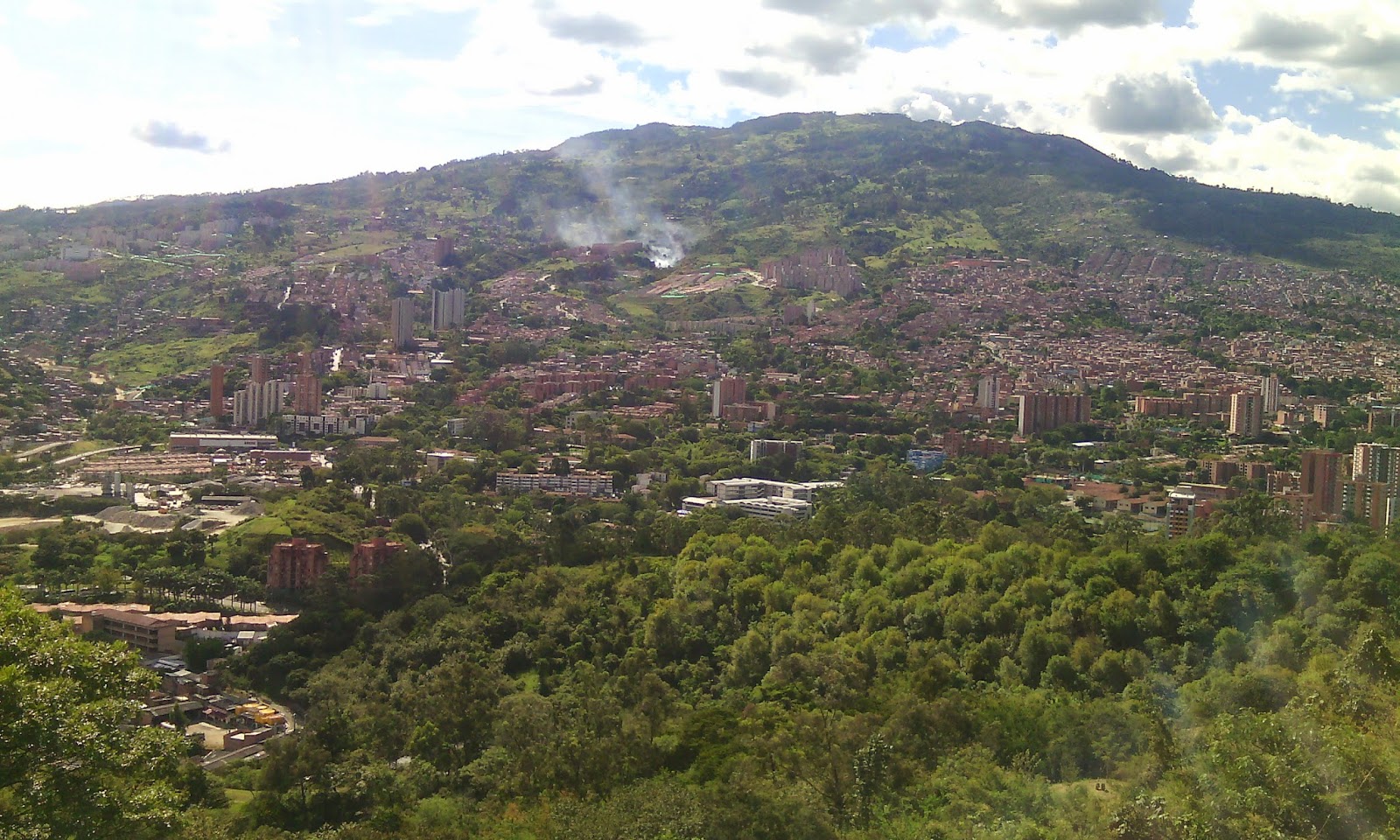
Sunday, September 28, 2014

Life beyond teaching: cello and nature

While most of my time here in Colombia is spent teaching (or preparing to teach), this past Friday I got to perform the first Bach cello suite as well as accompany the seminary choir for a piece during an annual concert put on by student development . I don't have my own cello here (I'm looking into my options to see about fixing that), but a friend of a friend in student development is a music student who had a spare cello, so with five days notice, I attempted to make up for months of not playing. My fingers were sore from lack of calluses and it was weird adjusting to a different instrument, but I think it came together reasonably well. This definitely reinforced my desire to get a cello here and get back into playing music regularly!

Seminary choir practicing for the concert, led by Santiago Benavides, a well-known Christian musician here and husband of the leader of the student development office.

My other main hobby, the outdoors, has definitely taken a backseat here, but two weeks ago I was able to go on a wonderful retreat with other faculty and staff from the seminary, where we got to enjoy nature around the reservoir at Guatapé, about two hours from Medellín. A very generous donor to the seminary paid for the entire seminary faculty, staff, and their families to attend this two-day retreat (in four groups), the first time this kind of thing has happened in years, if ever, due to the normally prohibitive cost. This was a huge blessing and was cool to see how great of a community there is here among all types of people, from the security guards and janitors to support staff, faculty, and administrators. This was a great chance to decompress from work, relax in nature, reflect spiritually, and get to know others from the seminary better than before.

On a hike overlooking the reservoir near Guatapé with friends who work in student development, English courses, extension programs, and the library.

"Boating" on the lake. The boat more resembled a motorized dock (you can see it in the picture below with the white chairs lined up on it).

View from our hotel in our own private part of the lake. Water level was noticeably low as Colombia has been in a relatively dry spell lately (with severe drought in the far north of the country).

Saturday, September 27, 2014

Preaching Proverbs Conference

Of all the books in the Bible to preach from, Proverbs would likely be one of the last I would pick, perhaps only surpassed by Ecclesiastes (I still don't have a very clear idea of what to do with most of the book) and Song of Songs (which I usually just read as fast as possible when I get there in my Bible reading plan, and then move on without lingering on the details). Wisdom literature is not exactly my strong point, especially if I were to try to figure out how to write a sermon outline on a passage.

This past week, however, the seminary hosted a conference on "Preaching Proverbs" as their annual Transformative Preaching conference in conjunction with Langham Partnership International, a ministry that grew out of John Stott's ministry and promotes quality preaching in the majority world. I was able to attend most of the morning sessions and learned quite a lot by seeing different models of expository preaching of a difficult book, all done by Latinos. Probably the most helpful thing for me was seeing how different types of texts and themes can legitimately produce different types of sermons. For example, Diego Cardona, a pastor and the preaching professor at the seminary here, preached a great sermon introducing the book and looking at the big-picture of the concept of wisdom and its connections to the gospel. Another preacher tied in quite a bit of his background in counseling, another focused on one single verse while going very deep in showing the relevance to our lives while drawing on his own life experience, another was brutally honest in discussing texts that deal with the struggles for sexual fidelity, and so forth. In other words, there's not one magic key to preaching Proverbs, but a range of options for communicating effectively what wisdom is about.

I don't know if it's because I'm getting older and realizing that the decisions I make at this stage in my life drastically affect where I will go in the future, but I feel like I'm getting to a point where the wisdom portions of the Bible are beginning to speak to me more. Perhaps this is the flip side of how a lot of people experience their faith. For many, Proverbs connects from the get go and later they go deeper in theology. For me, I've studied theology and the big picture of redemptive history for years, yet this conference has challenged me to remember that preaching (and the Christian life) has other dimensions than just making connections with the Bible's big story. Obviously to be truly wise we must recognize our need for the gospel, but I can't forget that so much of the Bible was written to hit home in daily life and decision making. God cares enough about our conformity to the image of Christ that he has given us pretty clear ideas about what leads to life and which decisions are just plain foolish.

Around 200 people attended the conference, well above expectations and a tremendously encouraging sign! In a country so lacking in quality preaching and nuanced applications of biblical texts, it was great to see so many pastors and other leaders seeking to grow in fidelity to God's word.

Singing a worship song with others attending the Preaching Proverbs conference in response to a sermon.

Thursday, September 18, 2014

Two courses wrapped up: Religious Systems, Vocal course

My primary course that has kept me extremely busy, Religious Systems, finished a week ago and I spent a good part of the past week grading papers and exams. I definitely encountered a sharp learning curve in the course regarding the educational system here, where students are coming from, how to assess students well without overwhelming myself with too much grading, and considering how to better contextualize courses for the Colombian context in the future. In spite of all the ways I can see to improve (something I'm sure will never go away), I've heard a lot of positive feedback from students as well as others on staff at the seminary who have spoken with students and said they have learned a lot. Below are a few pictures from the last day of the course, when we wrapped up looking at other belief systems with a discussion on how the church can help strengthen the faith of people facing doubts due to the existence of so much religious diversity and differences of opinion.

With the 23 students in my Religious Systems course.

Four of my students during a group discussion activity.

Brainstorming ideas as a class, drawing on the insights of the different groups.

This past Saturday we also wrapped up the Foundations of Vocal Technique course by having a small certification ceremony. Students prepared a song (the Spanish version of "Lord Most High"), the teacher (Claudia) sang, and I gave a 15-minute homily based on Psalm 95. The message sought to summarize the key themes we studied regarding theology of worship, namely, why we worship (because God is worthy of worship for who he is) and how we ought to worship (with a humble attitude and a heart willing to listen to God and obey him in all aspects of our lives).

Though the course ended with substantially fewer students than we had in the initial five-week module, we still had a decent group of around 15 students who stayed through the whole twelve weeks. I saw substantial improvement in the last few weeks and many students are hoping to be able to continue. I played a role in evaluating the course for the seminary, and they are going to offer the course again beginning in October, separated into two levels this time. I will likely continue to help out with the theology of worship portions, but not attend the rest of the classes from here on out.

Here are a couple of reflections on the theological part of the course from an interview I conducted after the last class:

  • Diana, a student involved with youth ministry and music at her church, said: “I have enjoyed the theological part of the class a lot because there are things that one understands erroneously in terms of worship and praise, ideas like thinking that worship is only a matter of singing or raising one’s hands. But worship is much more than just that.” 
  • Luz Marina, a lawyer who works with victims of the armed conflict in Colombia and who also serves in worship ministry at her church, said the following, "It has been very special to be part of this course because I haven't just learned vocal techniques to help me sing better, but I have also learned the role that worship and praise plays within a worship service and the congregation's gatherings".

Singing at the certification ceremony for the Foundations of Vocal Technique course (in the seminary chapel).


Sunday, August 10, 2014

But, how can they believe that and still be Jews (or Muslims, or Buddhists, etc.)?

My course studying different religious viewpoints and philosophies is halfway done and we have had a lot of interesting things happening in the last couple of weeks. 

To begin with, one of the required class activities was to visit a place of worship of another religion in order to hear directly from the perspective of non-Christians. I ended up organizing two class trips, one to a Tibetan Buddhist center and one to a mosque. Besides the mere fact of seeing that non-Christian religions exist in Medellín, I think the biggest value for students was seeing how what can seem like abstract philosophies or belief systems affect the lives of their followers. 

Students seemed a little taken aback at the Buddhist Center at how naturally the people there talked about reincarnation, karma, and so forth as completely common sense notions. (The person sharing wasn't Tibetan either, but a Colombian woman who has been a Buddhist for 14 years). 

At the mosque, the biggest surprise for students was hearing firsthand from a Muslim about how he does not believe that Islamic extremism has any real basis in the teachings of Islam. Many, myself included, had serious questions about his interpretation of the violence in the Middle East as 100% political and having nothing to do with religion, but it does go to show how important it is to listen and understand what particular people believe rather than stereotyping people from other faiths as monolithic wholes.

In that regard, probably the most surprising thing my students have heard so far came in a class on modern Judaism this past week. Two students did a presentation on contemporary Jewish views of the Messiah and interviewed a local rabbi as part of their research. They found out that many Jews don't believe in a personal Messiah figure, that they don't think the sacrificial system is necessary for salvation, that there's not a big push among many Jews to rebuild the temple, and that it's a common Jewish viewpoint to believe in reincarnation until the individual achieves his purpose for life by living righteously. Many students seemed stunned, because the tendency is to assume that Jews today are basically the same as Jews in the time of Jesus and that the political aspirations of evangelicals who hold to certain forms of dispensational theology are also the aspirations of all Jews.

We have also had some in-class debates where students have to defend an assigned religious viewpoint to the best of their ability. The goal isn't to win the debate so much as show an understanding of the strengths and weaknesses of different positions and an ability to respond to common objections. Our first one was a debate between Buddhist and Christian views of the nature of the human problem and how to overcome it. This week we're having one between Christian and Muslim viewpoints on the divinity of Christ. The third debate toward the end of the course will be on whether we need to affirm the existence of God in order to make sense of ethics. This will bring together a number of strands of upcoming classes dealing with naturalism, applications of naturalistic Darwinism to broader worldview issues (especially ethics), and existentialism. 

One of my biggest goals for this class is to develop critical thinking skills in students as they look at different religions and philosophies. Hopefully these activities are proving helpful for truly equipping students to engage critically with people who often think and live in drastically different ways.

Sunday, July 27, 2014

More Medellín Photos

View east from Cerro el Volador, a natural park on the top of a hill in the middle of Medellín, close to the seminary. If you look closely in the middle of the photo in the green area, you can see the raised train tracks of the Metro system.

View north from Cerro el Volador.

View southeast from Cerro el Volador.

View south from Cerro el Volador, looking at the park itself.

View southwest from Cerro el Volador.

View west from Cerro el Volador. The seminary is somewhere around the middle of the photo.
Watching the Colombia-Brazil World Cup match.

After a seminary chapel service, which we have every Thursday.
A street I often walk through on my way to the grocery store.
Metro tracks in the bottom of the valley.
A Catholic church and park I often walk by on the way to the grocery store.

Metro tracks and view of city.

In the city center.

View from a Metro station.

Metro train. They are amazingly clean, modern, and don't have people trying to sell anything on them. (This was a big shock after Mexico City. Busses here are another story.)

Sunday, July 13, 2014

Gender Equality Conference

This past Monday evening through Wednesday morning the Biblical Seminary of Colombia hosted a conference put on by Christians for Biblical Equality, an organization that advocates for the involvement of women in all ministries of the church and for gender equality in marriage. I ended up attending most of the sessions and doing some simultaneous Spanish to English translation for some of the introductory comments and one of the talks by Dr. Bill Spencer, a professor from Gordon-Conwell Theological Seminary, which addressed debates over Trinitarian theology as it relates to gender roles. This was my first time doing simultaneous translation, and I actually really enjoyed it. Thankfully I was going from Spanish to English, which is a lot easier than the reverse!

Sessions of the conference addressed issues related to interpretation of Old Testament and New Testament texts, theology, church history, and practical issues. Half a day was devoted to workshops, which I decided to use to attend workshops related to women’s standing according to Colombian law and issues of gender violence. These were helpful for understanding a bit more of the cultural context here in Colombia and the challenges and inequalities women still face. While not mentioned in these talks, it’s worth mentioning that one of the big challenges women face in ministry in Colombia is that churches often theologically accept women pastors, but they don’t want to pay them, or at least not at the rate they pay male pastors. It’s quite common to see pastoral teams of husband and wife here, and there is often a “two for the price of one” mentality.

The view from the translator's booth. I listened to the Spanish via headphones and simultaneously spoke an English translation, which was broadcast via radio to the headphones of those who only spoke English.

I know that among my friends and financial partners there is a wide variety of opinion on the often contentious issues related to gender roles. While I consider myself a moderate egalitarian, I respect where people are coming from on both sides of the women’s ordination debate and recognize I very well could be wrong on this issue. I don’t think most complementarians are chauvinists, and I try to challenge people on both sides to defend their views biblically and represent the opposing position in a fair way. The seminary here does not have an official position on the matter, but for practical purposes I would say the vast majority favor the egalitarian side. Our seminary president is a Colombian woman, and as of last semester 28% of the students studying on campus were women and 42% of the students in the online program. I was a little surprised the numbers were so high, given the reputation Latin America has for being machista, promoting male dominance.


One of the primary reasons for the significant presence of female seminarians, however, has to do with the prevalence of Pentecostalism in Colombia. Some significant Pentecostal denominations, like the Foursquare Church, were started by women (i.e. Aimee Semple McPherson), and most Pentecostals have recognized female preachers since their beginnings. For example, I know one male seminarian here whose mother was a pastor who founded a church in the rural outskirts of Medellín and a man who works in the extension office whose grandmother was a pastor. For most egalitarians here, their viewpoint has nothing to do with theologically “liberal” or “feminist” ideology and everything to do with churches that are committed to the Great Commission and have been open to providing opportunities for women to be part of that at every level. Whether one agrees with their exegesis or not, I think that’s worthy of respect. There are awesome opportunities here to provide deeper training to help people committed to God’s kingdom grow deeper in their knowledge of Scripture, and that's what excites me most about teaching here!

Friday, July 11, 2014

The Peculiarities of Colombian Vocab

By and large the Spanish I learned in Mexico has served me well here in Colombia. But there have been a few adjustments, sometimes actually back to words I had learned in Peru and had to unlearn in Mexico. For Spanish speakers or those who just find literal translations amusing, here are the things I've had to learn or relearn to sound a little more like a Colombian:

First, let's start with the truly unusual, the kinds of words that made me stop and go, "Really? You actually say that?" Interestingly, they all have to do with traffic.
1. At the top of the list is "taco," an extremely common word in Medellín to refer not to delicious Mexican food, but to a traffic jam. It's very common to here people say "hay mucho taco" (literally, "there's a lot of taco") when the streets are packed.
2. Continuing the traffic theme, paisas (people from Medellín) refer to a speed bump as a "policía acostado," literally a "lying down policeman," due to their effectiveness in reducing speeds even when police are absent.
3. "Oreja" is a common word meaning "ear," but I was taken aback when I heard some friends using it to refer to an offramp from a highway that circles back in cloverleaf fashion.
4. "Rompoy" is a word I have only heard one person use (my boss), but from looking it up online it's apparently somewhat common in Colombia to refer to a roundabout, which is normally called a "glorieta." The best explanation I've seen is that it is a corrupted version of the French word for roundabout, “rond-point.”

A few words I knew from Peru have reentered my vocabulary in Colombia:
1. Chévere = cool, as in "that's really cool," the equivalent of "chido" or "padre" in Mexican Spanish.
2. Gaseosa = soda, pop, instead of the Mexican "refresco."
3. Cancelar = to pay (but also can mean "to cancel"). For example, if you're at a bookstore, they may ask you to go to a separate counter where they accept the money in order to "cancelar" your order, then return to the other counter with the receipt to be able to take away your item. It gets a little confusing if you try using both meanings in the same sentence, saying, “La matrícula del estudiante fue cancelada porque no canceló el valor de la clase” = "The student's enrollment was cancelled because he didn’t pay [cancel] the value of the class."

Words for food:
1. Tinto = black coffee, with or without sugar, usually served in small cups of about 4 ounces. I’ve encountered it especially after church services or as refreshments at events.
2. Banano =  regular banana, which is called a "plátano" in Mexico.
3. Plátano = plantains, a larger starchy type of banana that is fried before eating, called "plátano macho" in Mexico.
4. Tomate = tomato. They don’t use “jitomate” for red tomatoes, as they do in Mexico.

Other words:
1. De pronto = maybe, perhaps. This is much more common than the alternate words for maybe, such as "quizá(s)" (which seemed predominant in Peru), "tal vez" and "a lo mejor" (quite common in Mexico), or the Argentine "capaz."
2. Afán = hurry. For example, "¿tienes mucho afán?" = "are you in a hurry?"
3. Hincha = fan (in sports). I'm not sure if this is etymologically related to the verb "hinchar" meaning "to swell," but it definitely confused me at first, until I saw article after article on the World Cup talking about the "hinchas" of the different teams.
4. Nevera = refrigerator. In Mexico they use "refrgerador" or "refri" as a shortened form.
5. Barbería = barber shop. I’ve seen both this and the usual "peluquería."
6. Seda dental = dental floss. Literally this means “dental silk,” instead of Mexico’s “hilo dental,” which literally means “dental string.”


On the use of tú and vos (informal words for "you")
There is a mixture of tuteo and voseo forms here, though it seems like only lately I’ve been starting to pick up on people using "vos." Maybe that means I’m meeting more people originally from Medellín or northeastern Colombia, where supposedly it is more common. According to this map on Wikipedia, Colombia is a very mixed bag regionally in the use of voseo.